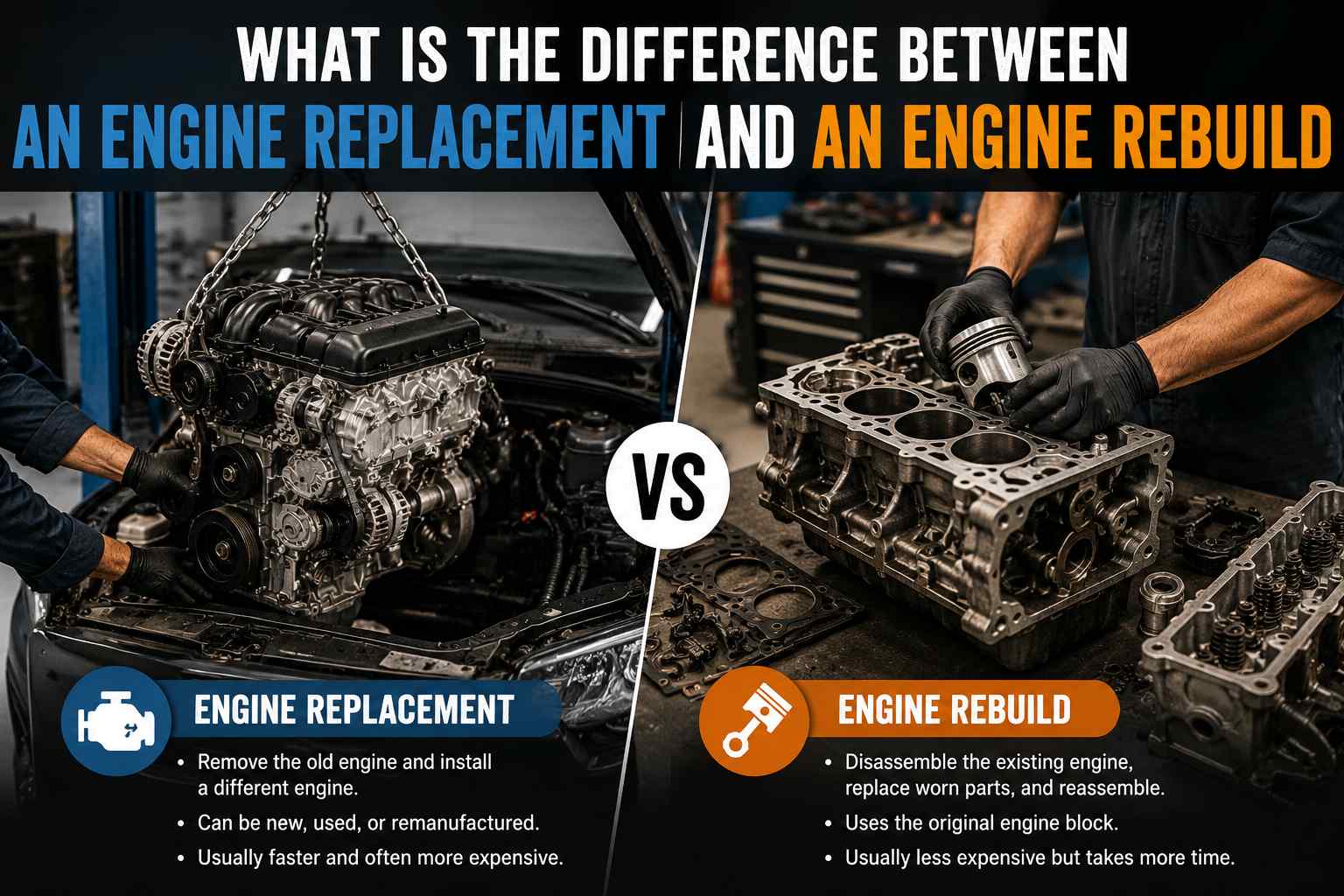
When an engine develops serious internal damage, vehicle owners often face a difficult choice: engine replacement vs engine rebuild. An engine rebuild restores the existing engine by repairing or replacing worn components, while an engine replacement removes the old engine and installs another compatible unit. The right option depends on the engine’s condition, the extent of damage, repair costs, vehicle mileage, warranty, and long-term plans for the vehicle.
A proper diagnosis should come before either decision. Replacing or rebuilding an engine without identifying the underlying cause can lead to unnecessary expense or another engine failure.
An engine rebuild involves disassembling the existing engine, inspecting its internal components, repairing or replacing worn parts, and reassembling it according to the manufacturer’s specifications.
The original engine block is generally retained when it remains structurally sound. Depending on the condition, an engine rebuild may involve replacing:
The crankshaft, cylinder walls, cylinder heads, and block are measured and inspected to determine whether they can be reused, machined, or replaced.
A quality rebuild requires more than replacing a few parts. Proper measurements, machining when necessary, correct clearances, suitable replacement components, and careful assembly all affect the result.
An engine replacement involves removing the existing engine and installing another engine that is compatible with the vehicle.
Examples include a severely cracked block, extensive cylinder damage, major overheating damage, or widespread internal failure.
The primary difference is straightforward: a rebuild restores the existing engine, while a replacement installs another engine.
| Factor |
Engine Rebuild |
Engine Replacement |
| Basic approach |
Existing engine is disassembled, repaired, and reassembled |
Existing engine is removed and another engine is installed |
| Original block |
Usually retained if structurally sound |
Removed from the vehicle |
| Internal components |
Inspected, repaired, machined, or replaced |
Included with the replacement engine |
| Initial cost |
May be lower when damage is limited |
May be higher depending on the replacement engine |
| Labor |
Includes teardown, inspection, rebuilding, and assembly |
Includes removal, preparation, installation, and testing |
| Machine work |
May be required |
Generally not part of the replacement installation |
| Repair time |
Can take longer because of inspection and machining |
May be quicker when a suitable engine is readily available |
| Warranty |
Depends on parts and repair provider |
Depends on whether the engine is new, remanufactured, or used |
| Best suited for |
Repairable internal wear or damage |
Severe or widespread engine damage |
| Key requirement |
Existing major components must be reusable or repairable |
A suitable replacement engine must be available |
| Long-term value |
Depends on rebuild quality and vehicle condition |
Depends on replacement engine quality and vehicle condition |
Neither option is automatically better. The condition of the engine and the overall condition of the vehicle should determine which approach makes sense.
Is It Cheaper to Rebuild or Replace an Engine?
Many vehicle owners ask, is it cheaper to rebuild or replace an engine? There is no universal answer because the total cost depends on the type and extent of engine damage.
A rebuild can be more economical when the engine block, crankshaft, cylinder head, and other major components are reusable. However, extensive machining and numerous replacement parts can increase the cost considerably.
A replacement engine may cost more initially, but it can become the more practical option when the original engine has extensive damage.
A meaningful cost comparison should include:
- Diagnostic and inspection costs
- Engine removal and installation
- Replacement parts
- Machine-shop work
- Labor
- Replacement engine cost
- Fluids and filters
- Related components that may require replacement
- Warranty coverage
- Potential future repairs
The lowest initial estimate is not necessarily the lowest long-term cost.
When Does an Engine Rebuild Make Sense?
An engine rebuild may make sense when the existing engine has significant wear but its major structural components remain usable.
A rebuild can be considered when:
- The engine block is structurally sound.
- Cylinder walls can be restored within acceptable specifications.
- The crankshaft can be reused or machined.
- The cylinder head can be repaired.
- Suitable replacement parts are available.
- The vehicle is otherwise in good condition.
- The total rebuild cost is reasonable compared with replacement.
A rebuild can address multiple worn internal components at once and may allow a vehicle owner to retain the original engine.
However, not every failed engine is a good candidate for rebuilding. The condition of the block and other major components must be established first.
When Is Engine Replacement the Better Option?
Replacement may be more practical when the existing engine has extensive damage that cannot be reasonably restored.
Common reasons to consider replacement include:
- A cracked engine block
- Severely damaged cylinder walls
- Major overheating damage
- Extensive crankshaft or bearing damage
- Severe oil-starvation damage
- Multiple major component failures
- Repair costs approaching replacement costs
- Limited availability of suitable rebuild components
The condition of the rest of the vehicle also matters.
For example, installing a replacement engine in an older, high-mileage vehicle may not provide good financial value if the transmission, suspension, electrical system, or other major components also need expensive repairs.
What Factors Should You Consider Before Choosing?
The decision should not be based on the engine price alone. Several factors can affect the overall value of rebuilding or replacing an engine.
Engine Block Condition
The condition of the block is one of the most important considerations. A structurally sound block can often support a rebuild, while severe cracking or deformation may make replacement more practical.
Extent of Internal Damage
Damage limited to certain components may favor rebuilding. Widespread damage affecting several major components can shift the decision toward replacement.
Vehicle Age and Mileage
A vehicle’s age and mileage should be considered alongside its overall mechanical condition.
A newer vehicle with a well-maintained transmission and chassis may justify major engine work. An older vehicle with multiple major problems may require a broader cost-benefit analysis.
Total Repair Cost
Compare the complete cost of both options.
For a rebuild, consider machining, internal components, labor, assembly, and testing.
For replacement, consider the replacement engine, removal and installation, fluids, required components, and any additional work.
Parts and Engine Availability
Parts availability can influence both cost and repair time. Some engines have extensive aftermarket and OEM parts support, while components for older or less common engines may be harder to source.
Warranty Coverage
Warranty terms can vary significantly between rebuilt, remanufactured, and used engines.
Before choosing an option, ask:
- How long does the warranty last?
- What components are covered?
- Is labor covered?
- Are there mileage limitations?
- Are there specific maintenance requirements?
Repair Time
A rebuild can require additional time for teardown, measurement, machining, parts ordering, and assembly.
A replacement may take less time when a compatible engine is readily available, although installation time varies by vehicle.
Long-Term Ownership
Consider how long you intend to keep the vehicle.
If you plan to drive it for several more years, the quality of the engine solution and warranty may be more important than simply choosing the lowest upfront cost.
New vs. Remanufactured vs. Used Replacement Engines
If replacement is recommended, the type of replacement engine is another important decision.
New Engine
A new engine is manufactured with new components and is generally the most expensive option. It can be appropriate when the vehicle’s value and long-term ownership plans justify the investment.
Remanufactured Engine
A remanufactured engine has previously been used but undergoes a controlled restoration process. Worn components are replaced, and critical components are inspected and tested.
The quality of remanufacturing can vary, so warranty terms, specifications, and the source of the engine should be reviewed.
Used Engine
A used engine comes from another vehicle and may cost less than a new or remanufactured unit.
However, its previous maintenance history, mileage, storage conditions, and operating history may be less certain. Buyers should ask about mileage, testing, compatibility, and warranty coverage.
What Are the Signs Your Engine May Need a Rebuild or Replacement?
Certain symptoms can indicate serious internal engine problems, but symptoms alone cannot determine whether an engine needs rebuilding or replacement.
Important warning signs include:
- Persistent knocking or tapping
- Knocking that becomes louder during acceleration
- Metal particles in engine oil
- Low oil pressure
- Excessive oil consumption
- Blue exhaust smoke
- Significant loss of power
- Persistent overheating
- Low compression
- Severe engine vibration
- Repeated engine warning lights
For example, engine knocking can result from several different problems. A damaged bearing, lubrication problem, combustion issue, or another mechanical fault can produce similar symptoms.
That is why a diagnostic inspection should come before making a decision about major engine work.
Get a Complete Auto Engine Diagnostics Check First
A complete auto engine diagnostics inspection can help determine what caused the problem and whether the existing engine can be repaired.
Depending on the symptoms, a technician may:
- Scan for diagnostic trouble codes.
- Review engine performance data.
- Inspect engine oil for contamination or metal particles.
- Check oil pressure.
- Perform a compression test when appropriate.
- Perform a leak-down test when necessary.
- Inspect the ignition and fuel systems.
- Check the cooling system.
- Inspect accessible engine components.
- Determine whether major internal components can be reused.
Additional testing may be required depending on the vehicle and symptoms.
The purpose of diagnostics is not simply to find a fault code. It is to identify the underlying cause and establish the condition of the engine’s major components.
Engine Rebuild Process Explained
The engine rebuild process explained below provides a general overview. The exact procedure varies based on engine design and damage.
1. Engine Teardown
The engine is disassembled so technicians can examine its internal components.
2. Cleaning and Inspection
Components are cleaned and measured for wear, cracks, warping, and other damage.
3. Machine Work
If necessary, the engine block, cylinder head, crankshaft, or other components may require machining to restore appropriate surfaces and clearances.
4. Component Replacement
Parts that do not meet specifications are replaced. Depending on the engine, these may include bearings, piston rings, gaskets, seals, and other components.
5. Reassembly
The engine is reassembled using the manufacturer’s specifications for torque, clearances, timing, and other critical measurements.
6. Testing
After assembly, the engine is tested to verify proper operation and identify any remaining problems.
The quality of the measurements, machining, replacement components, and assembly process can all affect the performance and service life of a rebuilt engine.
How Long Can a Rebuilt or Replacement Engine Last?
There is no guaranteed mileage for either a rebuilt or replacement engine.
Service life depends on factors such as:
- Quality of replacement components
- Quality of the rebuild or installation
- Proper machining and clearances
- Engine design
- Maintenance history
- Oil-change intervals
- Cooling-system condition
- Driving conditions
- Vehicle use
A properly rebuilt engine can provide substantial additional service when the original cause of failure is corrected and the engine is assembled correctly.
The same principle applies to replacement engines. The quality, history, installation, and maintenance of the replacement unit all influence its service life.
What Happens If You Continue Driving With a Damaged Engine?
Continuing to drive with serious engine damage can increase the severity of the failure.
For example, inadequate lubrication can cause additional bearing and crankshaft damage. Continued overheating can cause further damage to the block, cylinder head, and other components. Internal engine failure can also introduce metal debris into the lubrication system.
If an engine develops persistent knocking, low oil pressure, overheating, major power loss, or another serious symptom, prompt diagnosis is preferable to continuing to operate the vehicle and potentially increasing the damage.
How Do You Decide Between an Engine Rebuild and Replacement?
A practical decision-making process looks like this:
Diagnose → Inspect → Determine the extent of damage → Calculate the total cost → Compare warranty and expected service life → Consider vehicle value → Make the decision.
Before approving major engine work, make sure you understand:
- What caused the engine failure?
- Which components are damaged?
- Is the engine block reusable?
- Can the crankshaft and cylinder head be restored?
- Which components need replacement?
- What is the complete rebuild cost?
- What is the complete replacement cost?
- What warranty comes with each option?
- What other major repairs does the vehicle need?
- How long do you plan to keep the vehicle?
This approach provides a more reliable basis for choosing between rebuilding and replacement than comparing engine prices alone.
Final Takeaway: Engine Replacement vs. Engine Rebuild
The choice between engine replacement vs engine rebuild depends primarily on the condition of the existing engine and the overall value of the vehicle.
A rebuild can be appropriate when the engine block and other major components remain usable and the internal damage can be restored at a reasonable cost. Replacement may make more sense when the existing engine has severe structural damage, extensive internal wear, or repair costs that approach the cost of another suitable engine.
There is no universal rule that says rebuilding is always cheaper or replacement is always more reliable. The right decision requires an accurate diagnosis, a detailed inspection, a complete cost comparison, and consideration of warranty and long-term vehicle ownership.
For drivers researching auto engine rebuilding services or car engine replacement, the most important first step is to determine why the engine failed and whether the existing engine is structurally repairable. That information provides the foundation for making an informed repair decision.
If you are looking for a car repair shop near you in the Grand Rapids area, 616 Auto Repair can evaluate the vehicle and provide information about available engine repair options. The focus should be on understanding the condition of the engine and choosing the repair that makes sense for the vehicle—not simply selecting the lowest initial price.